Arébénor
Basséne
Basséne
Senegalese, born in 1974
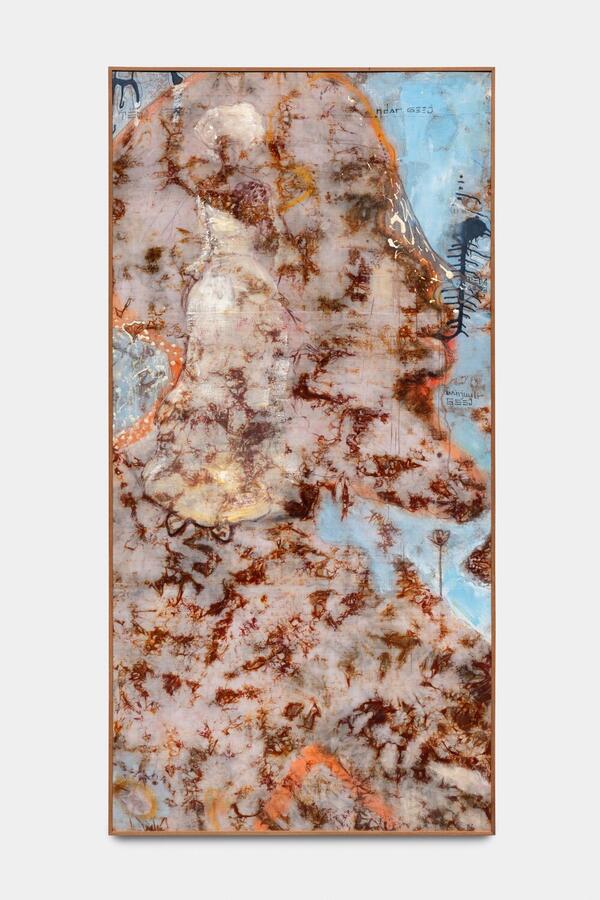
Arébénor Basséne uses a wide variety of materials, including gum arabic (once prized by foreign sailors along the coast of West Africa), the ink used to write the Quranic tablets, fouden (henna), wood residues, and natural pigments from the Dakar region. The canvases or papers he uses as supports are dipped in baths of wax and color, following the batik technique. The forms that emerge—imaginary landscapes, human figures sometimes in motion, sometimes fragmentary (heads, arms, feet, legs)—thus resemble visual archives, making multiple references to aspects of history that the Western perspective tends to overlook.
Basséne’s works indeed occupy the imaginary space between truth and myth. The plurality of history here finds echoes—partially indecipherable—that place the viewer in the role of a decoder, attempting to transform these objects, mysterious at first glance, into sources of knowledge. Much like the ancient scripts, children’s scribbles, street graffiti, rock engravings, or the embryonic writing of the mentally ill that interest Basséne, his works allow for a sensitive yet intellectual interpretation by the viewer, allowing them to uncover both alternative narratives to Western history and the latter’s gaps.