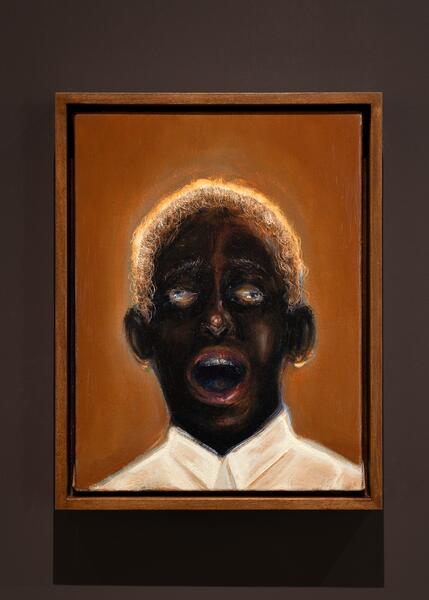
Cantor de coral – estudo
Oil on canvas
33 × 25 cm
The relationship between religion and the human body runs throughout Antonio Obá's work. Born in 1983, Obá initially wanted to become a priest, but found in art a way to preserve his Catholic beliefs while escaping the rules and injustices of organized religion. Through art, he achieves a higher and more open level of spirituality that allows him to imagine a redemption of the Black body (including his own), which he frees from the violent vestiges of slavery and reductive eroticization. He elevates and illuminates the Black body, lifting it out of a dark situation of shame and exploitation to a state of dignity, nobility, and power.
In this painting, a luminous aura envelops the head of a young boy who, with his mouth open, is about to release the emotions he feels in the form of sounds so that others can perceive them. Some of the most powerful music has been born from the depths of human suffering, and it is unclear whether this boy is uttering a cry of resistance, rebellion, strength, or warning, or a combination of all these cries, stemming from the primordial cry he uttered when he came into the world. By focusing on a single singer, Obá prevents his voice from blending into the choir, thus paying tribute to the importance of individual contribution, which too often dissolves into the group.
This work is held by the Pinault Collection and was first presented at the "Corps et âmes" de Commerce in 2025.
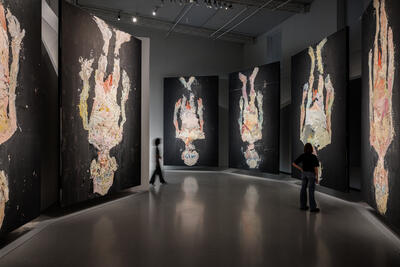
© Tadao Ando Architect & Associates, Niney et Marca Architectes, agence Pierre-Antoine Gatier. Photo : Nicolas Brasseur / Pinault Collection.
View of the exhibition "Corps et âmes", Bourse de Commerce – Pinault Collection, Paris, 2025.