Fabulation
Acrylic on canvas
Tryptic : 230 x 280 cm each panel
In Fabulation, a triptych whose panels can also be separated, Giulia Andreani gives a personal and enigmatic reinterpretation of history, drawing on photographs from the Condé Nast archives (a publishing group that owns, among others, Vogue, Vanity Fair, and The New Yorker—part of its archives belongs to the Pinault Collection), which she reconfigures in a monochrome palette of Payne’s gray, a technique that has become characteristic of her practice.
On the left panel, based on at least four photographs, Justine Johnstone, an American actress from the early 20th century, is painted in the white outfit she wears in the 1916 photograph showing her as a nurse. Jesse Owens, an African American athlete who became a symbol of the fight against racism after winning four gold medals at the 1936 Berlin Olympics, is depicted with his shoulder appearing dislocated, faithful to the photograph by Lusha Nelson taken in 1935.
In the central panel, Estelle Winwood, another actress from the early 20th century, is depicted in the studied pose she struck for Adolf de Meyer in 1919, now set amid the ruins of London photographed by Cecil Beaton in 1940; a British flag fluttered above them, which Andreani transformed into a white flag. In the foreground, the gaze—at once pained and resolute—of a young girl photographed by the same De Meyer in 1919, drawing the viewer in, reinforces the strangeness of the composition, which also alludes to the martyrdom of Saint Lucy, whose eyes are depicted in the style of Francesco del Cossa.
On the right panel, actress Lauren Bacall lies languidly on a wooden plank that is only partially visible, as in Ralph Crane’s 1945 photograph. Andreani’s depiction of her, however, is the result of a horizontal inversion, and the background has been replaced by a view of the Villa Foscari, also known as “La Malcontenta.” A Palladian residence built not far from Venice in the mid-16th century, the boat crossing its reflection in the water now bears another name: “Beware of the Painter.”
These three panels thus provide a crucial example of the artist’s exploration, which “requires ‘pre-existing’ images in order to function, through painting, as a kind of re-vision of the world and of history.”
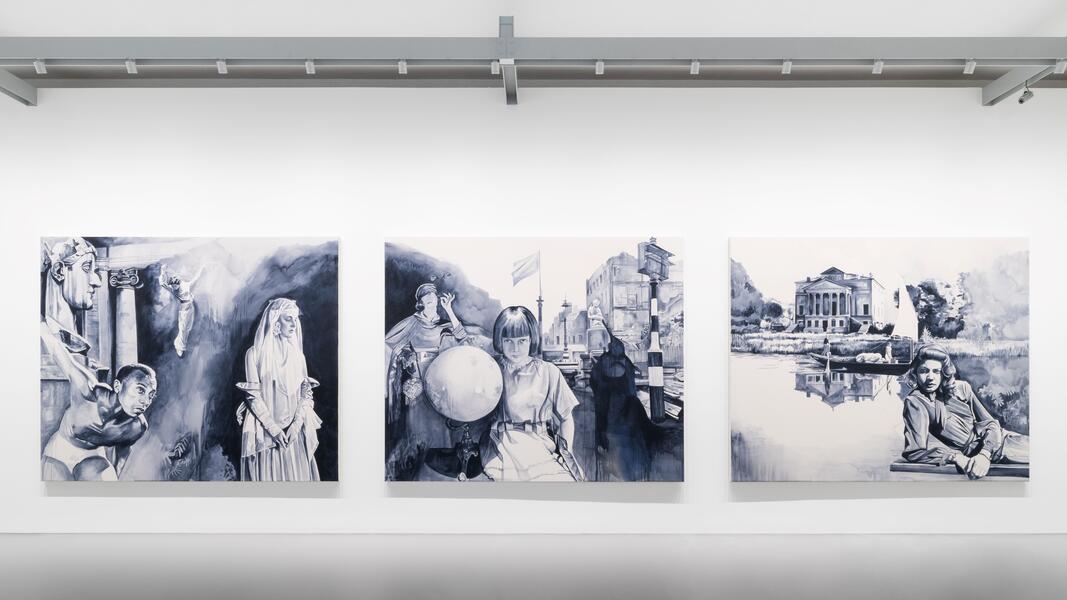
Photo: Marco Cappelletti © Palazzo Grassi
View of the exhibition « Chronorama Redux », Palazzo Grassi, Venice, March 2023-January 2024
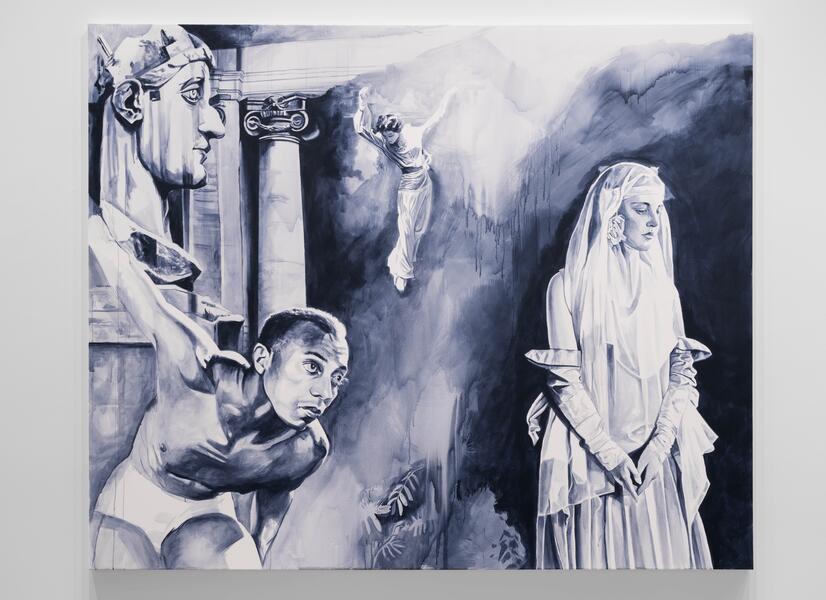
Photo: Marco Cappelletti © Palazzo Grassi
View of the exhibition « Chronorama Redux », Palazzo Grassi, Venice, March 2023-January 2024
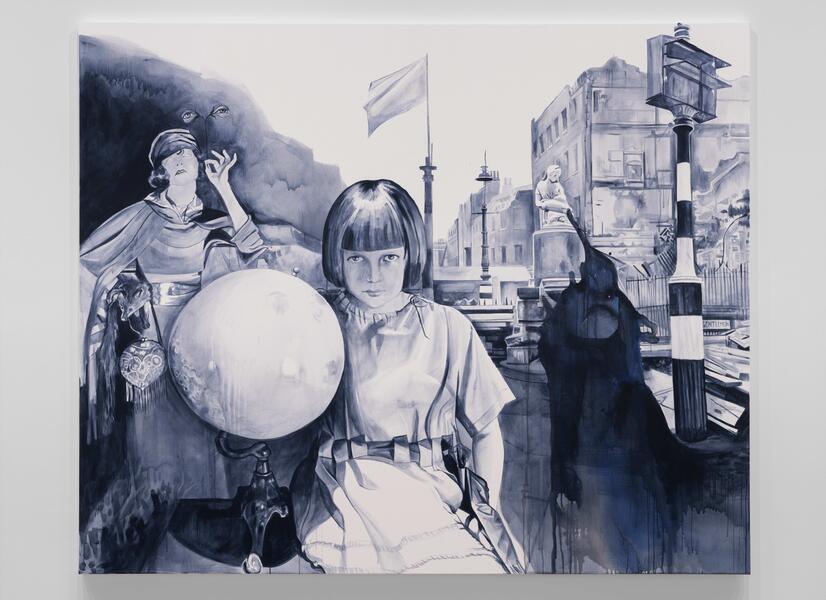
Photo: Marco Cappelletti © Palazzo Grassi
View of the exhibition « Chronorama Redux », Palazzo Grassi, Venice, March 2023-January 2024
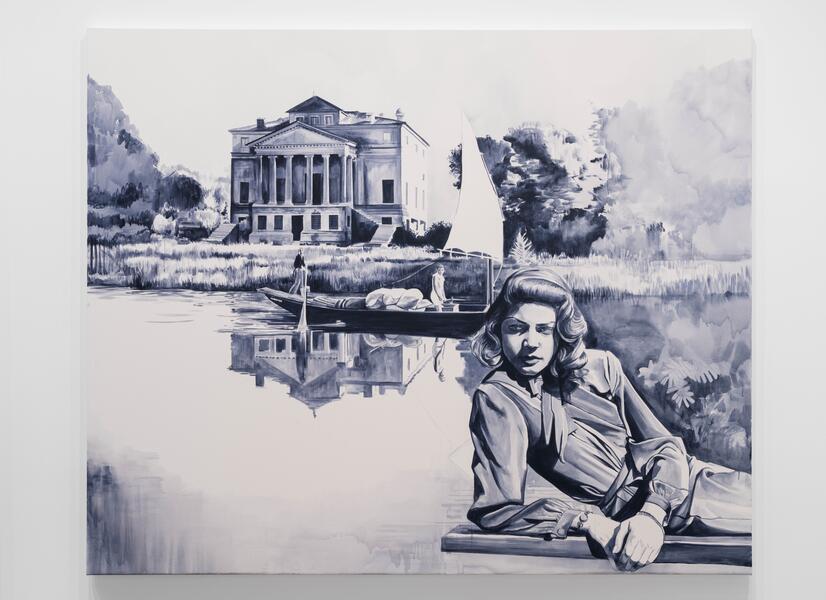
Photo: Marco Cappelletti © Palazzo Grassi
View of the exhibition « Chronorama Redux », Palazzo Grassi, Venice, March 2023-January 2024